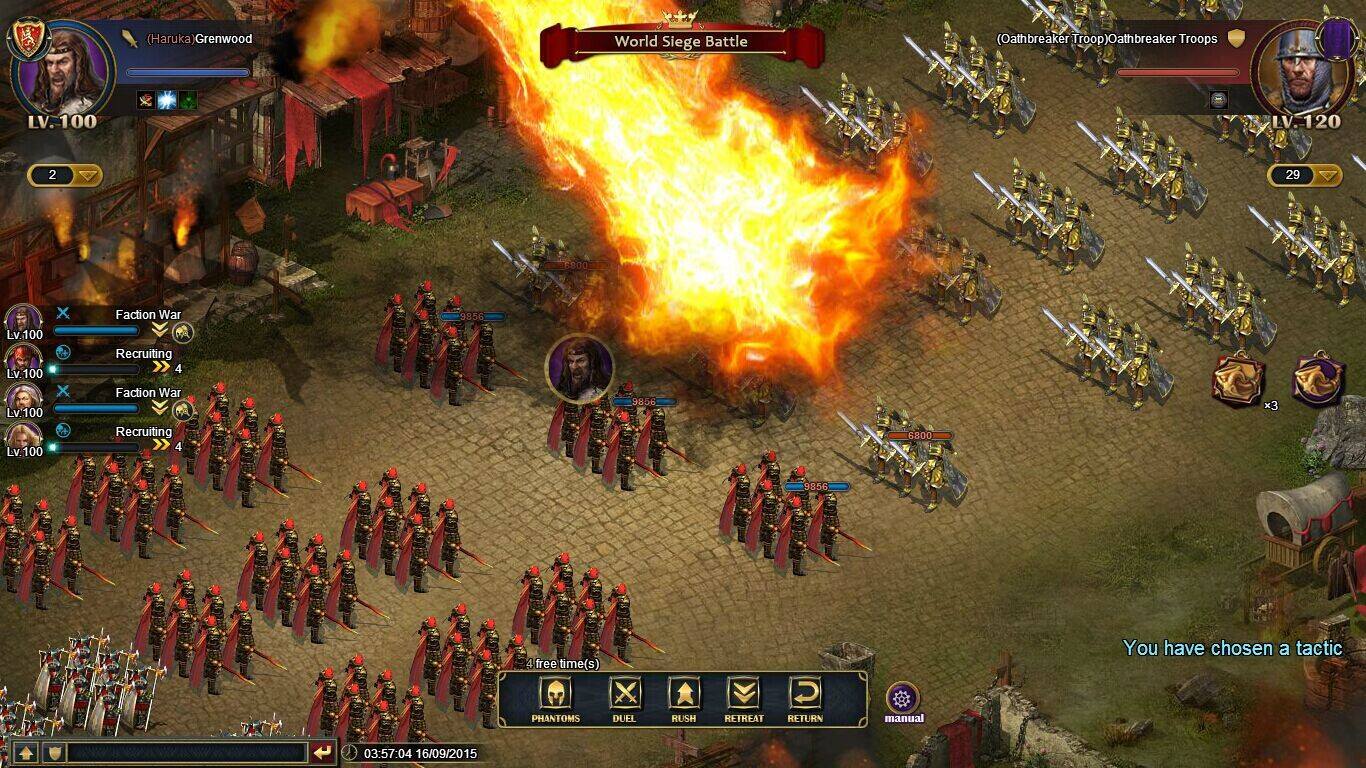
| Siege of Gondor | |
|---|---|
| Conflict: War of the Ring | |
| Date: 13 March - 14 MarchT.A.3019 | |
| Place: Minas Tirith and fields of Pelennor, Gondor | |
| Outcome: Siege broken by Gondor and Rohan | |
| Combatants | |
Gondor, Rohan | Virtua fighter wolf. Mordor, Harad, Rhûn, Khand |
| Commanders | |
| |
| Strength | |
Unknown number engaged | Unknown number engaged |
| Casualties | |
Heavy | Heavy |
| War of the Ring |
|---|
| Osgiliath (1) · Fords of Isen · Isengard · Hornburg · Osgiliath (2) · Dale · Siege of Gondor · Pelennor Fields · Black Gate · Dol Guldur · Bywater |
The Siege of Gondor, also known as the Siege of Minas Tirith after Gondor's chief city, was a series of battles waged by Sauron aimed at the capture of Minas Tirith, as part of the War of the Ring. The siege was broken by the Battle of the Pelennor Fields.
|
[edit]History
Directed by Renzo Martinelli. With Rutger Hauer, Raz Degan, F. Murray Abraham, Christo Jivkov. German Emperor Barbarossa will stop at nothing to conquer and build his empire. But a young man from Milan, along with his army of 900 men known as the Company of Death, is prepared to challenge the Emperor. Death Slash - Siege Lord delivers 3 powerful strikes with his claymore heavy sword before putting it through his enemie's gut. Oath of the Moment -.
- Main article: War of the Ring
[edit]Prelude
According to Sauron's policy to find his One Ring and conquer Gondor, on 20 June3018 he sent the Lord of the Nazgûl to attackedOsgiliath.[1] Although the chief and secret purpose of the battle was to release the Nazgûl for the hunt, it also served to test Denethor's strength and to destroy the bridge across the river.[2]
For months thereafter Sauron continued to amass his forces in Mordor.[3] However, the deliberate pace of his preparations were thrown into turmoil on 6 March3019[1] when Aragorn looked into the Orthanc-stone and revealed himself, the heir of Isildur, and Andúril to Sauron.[4] In response Sauron ordered all of his ready forces to immediately prepare to take the capital city of Gondor.
Gandalf arrived with Pippin at Minas Tirith on 9 March.[1] Most of the citizens were sent south and west, except those in the arts of healing and boys who refused to leave. The same day, 3,000 men from Belfalas, Dol Amroth and other places arrived to assist the garrison. But, it was less then a tenth of what was needed. Most that were needed were holding off the Black Fleet of Umbar. As evening drew on darkness began flowing out of Mordor.[5]
On 10 March, the Dawnless Day,[1] Gandalf saved Faramir as he was pursued closely by the Nazgul. Denethor, upon hearing the report of his son on the doings in Ithilien, who allowed the Ring-Bearer go free, reprimanded him for his decision. He also did not share his son's opinion that Osgilith was a liability. Faramir accepted the dangerous, perhaps suicidal, charge of defending the ruined city and the Rammas Echor, riding for Osgiliath.[6] From the Morannon an army came forth, took Cair Andros, and entered Anórien. In the evening a host issued from Minas Morgul and headed towards Osgiliath.[1]
[edit] Battles at Osgiliath and the Rammas Echor
On the morning of 11 March[1] the Lord of the Nazgûl led the assault upon the western side of Osgiliath. Many boats had been built in secret which allowed them to swiftly overwhelm the defenders, who despite their fierce defence, could only do minimal casualties to the forces arrayed against them. On 12 March[1] Faramir retreated to the Rammas Echor. The wall did not hold long as the invaders blasted many breaches through the defences. Gandalf, upon learning the Lord of the Nazgûl was on the field, went from the city to assist the beleaguered forces. On 13 March,[1] as Faramir retired to the city he fell wounded while battling against an Easterling champion. Only a charge by Prince Imrahil and the Knights of Dol Amroth saved him. As the defenders retreated to the city, a sortie of calvary sent out by Denethor scattered the pursuit and allowed them to come in unharried. Denethor, upon seeing his son wounded and unconscious, lost his will to fight and gave no more thought to the defense of his city.[6]
Mafia video game. Mafia: The City of Lost Heaven is a sandbox third-person shooter video game that was released for PC in 2002 and later released on Playstation 2 and Xbox in 2004. It was developed by Czech based Illusion Softworks, published by Gathering of Developers, and both written and directed by Daniel. Lost Heaven is a city located on the East Coast of the United States with 1,200,000 inhabitants. It is a bustling metropolis with many features expected in a large coastal city such as public transport, busy streets, skyscrapers, hotels and a busy shipping Port. Due to the Great Depression the. Mafia or Mafia: The City Of Lost Heaven is a 2002 action-adventure video game developed by Illusion Softworks and published by Gathering of Developers.The game was released for Microsoft Windows in August 2002, and later ported to the PlayStation 2 and the Xbox consoles in 2004, in North America and Europe. The game traces the rise and fall of Tommy Angelo, a fictional mafioso in the 1930s.
[edit] The Siege
The defenders of Minas Tirith watched all day on 14 March[1] as the hosts of Mordor dug pits and set up siege weapons beyond their range. At first they mocked the supposed foolishness. But, as the Nazgul continued swooping near the city and uttering cries of death, their morale dropped. The Mordor host then used their siege engines to launch stones at the city, many of which burst into flame as they came crashing down. Then, the heads of all those that had been slain in battle were flung over the city. The whole first level was soon in flames.
Seeing that the defenders' will was already broken, near midnight the Lord of the Nazgûl launched his assault upon the city. Swathes of defenders fled to the higher levels, but enough stayed at their posts that many attackers were killed trying to reach the walls. Most of the siege towers were also destroyed as they rolled forward. These defenders were soon overrun, however, and either fled or were slaughtered. Breaching explosives were set upon the wall, and flashes of fire and deep rumbling roared in the night as the host of Mordor began blasting down the wall. The Witch-king moved in to conquer the first level himself.
The hardest thrust was made against the Great Gate. The Witch-king rode beside the battering ram Grond. When it began to strike the gate, the Witch-King cried spells that reinforced it and weakened the gate; in only three strikes the gate was broken. All fled but Gandalf, whom stood defiant. The Lord of the Nazgûl mocked him and drew his sword, flames coursing down the blade; however, in this moment the winds began to blow away the clouds Sauron had gathered over Gondor, a cock crowed and horns blown in the north heralded the coming of the Rohirrim. The Lord of the Nazgûl left to deal with the Riders of Rohan and the Battle of Pelennor Fields ensued. The siege was broken during the battle.[6]
References
- ↑ 1.01.11.21.31.41.51.61.71.8J.R.R. Tolkien, The Lord of the Rings, Appendix B, 'The Great Years'
- ↑J.R.R. Tolkien, Christopher Tolkien (ed.), Unfinished Tales, 'The Hunt for the Ring'
- ↑J.R.R. Tolkien, The Lord of the Rings, The Two Towers, 'Of Herbs and Stewed Rabbit'
- ↑J.R.R. Tolkien, The Lord of the Rings, The Return of the King, 'The Passing of the Grey Company'
- ↑J.R.R. Tolkien, The Lord of the Rings, The Return of the King, 'Minas Tirith'
- ↑ 6.06.16.2J.R.R. Tolkien, The Lord of the Rings, The Return of the King, 'The Siege of Gondor'
| Siege of Chester | ||||||
|---|---|---|---|---|---|---|
| Part of the First English Civil War | ||||||
Morgan's Mount, a Royalist gun platform which was part of Chester's defences in 1645 | ||||||
| ||||||
| Belligerents | ||||||
| Royalists | Parliamentarians | |||||
| Commanders and leaders | ||||||
| Lord Byron, King Charles I | Sir William Brereton, Colonel Michael Jones | |||||
The Siege of Chester was a siege of the First English Civil War, between February 1645 and January 1646, with an intermission during the summer of 1645.
From the beginning of the war, the city of Chester was held by forces loyal to Charles I of England. It was first besieged in late 1644, but was relieved in March 1645 by Prince Maurice. With fighting continuing around Cheshire, the siege was not pursued again in earnest until September 1645, continuing ferociously until the following January. At the Battle of Rowton Heath in September, Charles himself failed to lift the siege, suffering a disastrous defeat.
Throughout the siege, which varied considerably in intensity, the garrison was commanded by Lord Byron, who in the final months strongly defended the city against great odds. In January 1646 (1645, old style), faced with the starvation of the inhabitants, Byron was persuaded to surrender, and the city was occupied by forces of the New Model Army under Sir William Brereton.
Background[edit]
The city of Chester, in Cheshire, was an important stronghold in the English border country, commanding an important crossing of the River Dee and thus the approach to North Wales. With strong city walls, dating originally from Roman times, Chester was a Royalist stronghold from the beginning of the civil war. Early in the war, between 1642 and 1643, its walls were strengthened and a new ring of earthwork defences was added outside them.[1]
After Lord Byron was defeated at the Battle of Nantwich in January 1644, he marched his remaining forces to Chester, making it his base for resistance to the Parliamentarian forces in Cheshire under Sir William Brereton. During the first half of 1645, Brereton was able to gain control of most of Cheshire, but the King's men in Chester commanded the river crossing into North Wales, still held by the King, protecting it from a Parliamentary invasion.[1]
February to March 1645[edit]
In February 1645 (1644, old style) Brereton mounted a determined assault on Chester, in the course of which a force of his men tried unsuccessfully to scale the walls near the Northgate. Defeated, he began to besiege the city.[2] Because the Parliamentarians took over, this meant that Morgan's Mount was closed in 1646 because it was a Royalist's gun house.[citation needed]
In March, Prince Maurice of the Palatinate arrived to relieve the city. However, having done so, when he moved on in April he took with him a large part of the garrison, including some 1,200 hardened Irish fighting men. Chester was left with only some six hundred regular soldiers, together with its own civilians who were able to bear arms.[1]
Summer of 1645[edit]
On 14 June 1645, Charles's main army was decisively beaten at the Battle of Naseby by the New Model Army under Sir Thomas Fairfax. The King then withdrew to Hereford, hoping for more reinforcements from Wales and Ireland. Early in July 1645, he lodged at Raglan Castle in Wales. On 10 July his army in the west of England under Lord Goring was heavily defeated at the Battle of Langport,[3] and news also reached Charles that an army of Covenanters was marching south. At the beginning of August 1645, Charles left Raglan with some 2,500 men, marching northwards along the Welsh border in the hope of rallying more Royalists to his cause in the north of England. He reached Doncaster on 18 August, where he had news that both the Parliamentary Northern Association army and a force of Covenanter cavalry were moving towards him. He quickly withdrew to Newark and then to Oxford, by way of a punitive attack on Huntingdon, Oliver Cromwell's home town and Parliamentary base.[2][4]
On 30 August the King marched to the assistance of his forces at Hereford, by now under siege by Lord Leven's Covenanters, but as the royal army approached news reached Leven of Montrose's victory on 15 August at the Battle of Kilsyth. He abandoned the siege of Hereford, marching north, so that Charles was able to occupy the town on 4 September. The King returned to Raglan, where some two weeks later he received news that Prince Rupert had surrendered Bristol. After Lord Digby persuaded Charles that Rupert had surrendered prematurely, the King dismissed Rupert and the two were estranged.[5]
September 1645 to January 1646[edit]
With his remaining forces, Charles marched north from Raglan, hoping to join Montrose, not knowing that on 13 September Montrose had suffered a catastrophic defeat at the Battle of Philiphaugh.[6] The Committee of Both Kingdoms instructed Sydnam Poyntz to pursue and contain the King, and Poyntz advanced for that purpose with a mounted force of some three thousand cavalry and dragoons.[7] The King moved northwards, without meeting Poyntz, and on 22 September he reached Chirk Castle where he received news of a new attack on Chester.[2][4]
With the surrender of Bristol, Chester had become the only seaport in England under Charles's control where it would be possible to land the reinforcements he was awaiting from Ireland, which he hoped could save him from ultimate defeat.[4]
Early on 20 September 1645, just before daylight, a New Model Army force of more than seven hundred infantry and an equal number of cavalry, led by Colonel Michael Jones, began a fresh assault on Chester. The attack broke through the outer Royalist earthworks around the eastern suburbs. After Jones had ordered the burning down of the urban areas in front of the east gate, he moved artillery up to St John the Baptist's Church to bombard the city wall. By 22 September, the King arrived at Chirk, but Jones's guns had already created a breach in the walls.[1][4]
The King made for Chester with all possible speed. Word that he was coming was passed on to the garrison commander, Lord Byron. The King reached Chester on 23 September[1] with an advance party consisting of his lifeguards, Gerard's brigade of some six hundred horse, and a small number of foot soldiers. This force was able to enter the city from the western bank of the River Dee because it was still under Royalist control. Meanwhile, in the hope of trapping the besieging forces between the king's main army and an enlarged garrison within the city, Sir Marmaduke Langdale took more than three thousand of the King's cavalry northwards towards Chester, crossing the Dee over Farndon Bridge, Holt, at dawn on 24 September.[1][4]
Moving north-east, Langdale received reports near the village of Rowton that Poyntz's Roundhead cavalry was approaching Chester from Whitchurch, Shropshire. Poyntz, who had ridden through the night to meet the royal army, met Langdale at Rowton Moor. All morning, both forces held their ground, but at about 2:00 pm, Jones sent part of his siege forces to join those of Poyntz. Charles is said to have watched the ensuing defeat of his forces at the Battle of Rowton Heath from the Phoenix Tower on Chester's city walls, when Parliamentary forces routed the remaining Royalist cavalry.[4] The dead included the King's cousin Lord Bernard Stewart.[1]
On 25 September, leaving Byron in charge of the garrison, the King retreated from Chester to Denbigh in North Wales with only five hundred mounted men.[1] As Byron refused to surrender, the Roundheads extended their siege works around the city and continued their bombardment.[citation needed]
For more than four months, the Royalist garrison resisted all Parliamentarian attempts to enter the city and even mounted counter-attacks. But as autumn became winter, many inhabitants died of starvation. In January 1646 (1645, old style), William Ince, as Mayor of Chester, persuaded Byron to surrender the city. On 3 February, the forces of Brereton occupied Chester.[1][2]
Gallery[edit]
During the siege, the Royalist Captain Morgan placed guns on this watch tower, now called Morgan's Mount. Skeletons were found here beneath the walls when the Chester Canal was dug a century later.
The battlements of Chester Castle were used by the Royalist garrison for artillery platforms.
Civil war musket ball damage still visible on Bonewaldesthorne's Tower
Damage by civil war cannonballs are still visible on Barnaby's Tower.
St John the Baptist's Church, on the site of the city's cathedral before the construction of the Norman building, was badly damaged by the Parliamentarians during the siege. Only its western transepts were reconstructed in the 19th century.
The Phoenix Tower, from which King Charles is said to have watched the defeat of his forces at the Battle of Rowton Heath.
An 18th-century plaque on the Goblin Tower, marking the repairs to the city walls following heavy damage during the civil war.
See also[edit]
References[edit]
- ^ abcdefghiC. P. Lewis & A. T. Thacker, eds., 'Early modern Chester 1550-1762: The civil war and interregnum, 1642-60', in A History of the County of Chester: The City of Chester: General History and Topography (Vol. 5, part 1, of Victoria County History of Cheshire, 2003), pp. 115-125, accessed 12 August 2011
- ^ abcdThomas Baines, Lancashire and Cheshire, past and present: a history and a description of the palatine counties of Lancaster and Chester .. from the earliest ages to the present time, vol. 2 (W. Mackenzie, 1868), pp. 496-509
- ^English Heritage Battlefield Report: Langport 1645 web page by English Heritage, accessed 9 August 2011
- ^ abcdef1645: The Siege of Chester and Battle of Rowton Heath at british-civil-wars.co.uk, accessed 19 September 2011
- ^Charles Spencer, Prince Rupert: the Last Cavalier (London: Phoenix, 2007, ISBN978-0-297-84610-9), p. 160
- ^A. Campbell, A dispatch announcing the defeat of the Scottish rebels at Philiphaugh (1645), quoted in Battle of Philiphaugh report by Battlefields Trust, online at battlefieldstrust.com
- ^D. N. Farr, 'Poyntz, Sydenham (bap. 1607)' in Oxford Dictionary of National Biography (Oxford University Press, 2004); online edition (subscription required), October 2006
Further reading[edit]
- John Broster, History of the siege of Chester, during the civil wars in the time of King Charles I (Chester, Broster & Son, 1800)
- Peter Young and Wilfrid Emberton, Sieges of the Great Civil War (London, Bell & Hyman, 1978)
- A. H. Burne & Peter Young, The Great Civil War, a military history (London, 1958)
- S. R. Gardiner, History of the Great Civil War (Vol. 2: London, 1889)
- Stuart Reid, All the King's Armies: a military history of the English Civil War (1998)
- T. F. Henderson, 'David Leslie, first Lord Newark', in Oxford Dictionary of National Biography (2004)
- JB, ed., 'John Byron's account of the siege of Chester 1645-1646' in The Cheshire Sheaf, 4th series, 6 (1971), from Rawlinson MS B210 in the Bodleian Library